How Hplc Is Utilized To Inspect Peptide Purity
Peptide Analysis Services When the item is authorized, the conformity pressure morphs from a worry of demonstration to a burden of upkeep. The annual product review need to demonstrate that the verified technique remains to function as anticipated within its statistical guardrails; inconsistencies need corrective actions that are in turn investigated. Method transfer to a contract organisation calls for side-by-side equivalence research studies, due to the fact that the regulatory authorities will certainly not accept a brand-new research laboratory just asserting that it is using "the very same" column and mobile stage. Ultimately, the current development of formal ICH Q14 standards on logical treatment growth is promoting a lifecycle technique in which recognition is no more a single obstacle yet a living record constantly refined by real-time information. Hence governing conformity is not an external charge grafted onto peptide science; it is the official language whereby analytical rigour is converted right into client protection and industrial resilience. Unrefined peptides go through gel filtering adhered to by HPLC purification. HPLC purification is executed by the state-of-art HPLC system with Empower Chromatography Manager. The system is validated by licensed Seas validation professional to comply with FDA criteria. The purity of the peptide is verified by running logical HPLC followed by mass spectrum evaluation. Researchers after that measure how much of the total signal belongs to the major peak. If 98% of the signal originates from the right peptide, the product is classified "98% pure by HPLC." This is a standard method of sharing peptide quality across research study and pharmaceutical industries. NorthEast BioLab always exceeds assumptions on bioanalytical assay development, recognition, and sample analysis. At Peak Peptide Supply, every peptide is verified through HPLC and MS testing, giving researchers confidence in their work and reliable outcomes whenever. Research-grade peptides must have pureness degrees of 98% or greater, with premium distributors using 99.0% to 99.7% pureness. Greater purity ensures much better research results and lowers disturbance from contaminants. Yes, study peptides are lawful in the UK when sold and purchased purely for research laboratory research study purposes. For assay reproducibility, HPLC Approach Growth counts on the best mix of pumps, analytical columns and pre-columns, mobile stage, and autosampler problems. HPLC Method Validation guarantees appropriate assay selectivity, level of sensitivity, and reproducibility. We see logical data not as a deliverable to be "delivered," but instead as a living artefact that requires to stand the examination of time long after the billing has been cleared up. Therefore, every service component, be it a tailor-made pollutant account, a stability protocol, or a regulative dossier, is designed for traceability, story-telling, and future-proofing.
Why Select Us For Hplc Approach And Hplc Analysis Service?
As an experienced CDMO, we offer access to cutting-edge logical tools, specialist approach growth, and support with the regulative maze. We concentrate on helping tiny pharma services like yours navigate the intricacies of peptide formulas with first-class analytical solutions. With that said being claimed, creating peptides can be difficult since they weaken easily and are exceptionally sensitive to environmental conditions. This is where analytical testing for peptide formulas ends up being vital.How Pureness Is Determined
Just how much does peptide HPLC screening price?
The expense of peptide evaluation solution varies considerably based upon which methods your governing package Click here! requires: HPLC-UV Evaluation: $& #x 24; 300 & #x 2013; & #x 24; 800 per sample (basic pureness evaluation) LC-MS (Fluid Chromatography-Mass Spectrometry): $& #x 24; 600 & #x 2013; & #x 24; 1,500 per sample (molecular weight confirmation).
Stability And Destruction Studies
- Exact logical validation is vital to validate peptide identification, pureness, and stability.
- It does not transform a research compound into a medical product, and it does not change speculative recognition in the researcher's very own system.
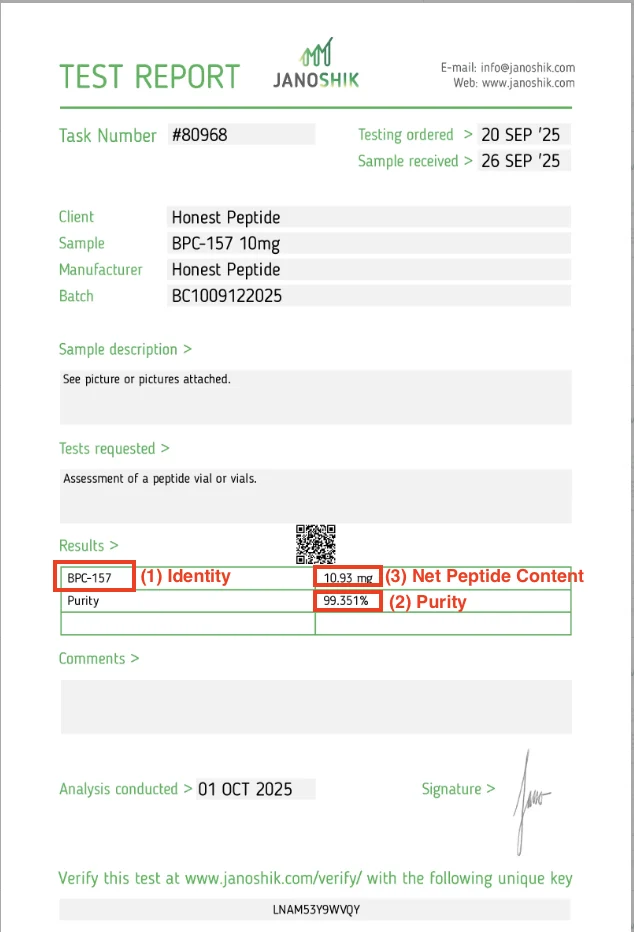
- For peptides, HPLC separates all the particles present in a sample, revealing whether it's made up of primarily the peptide you want-- or if there are unwanted byproducts left over from synthesis.
- These pieces are usually smaller sized than the target peptide and might elute at different retention times.